Open to remote projects and part-time/contract work

Zubair TanveerE-commerce Manager

Shopify Google Ads & Merchant Center Meta Ads AI Automation

A manager who builds. I run e-commerce operations and teams, build and customize Shopify stores, and drive paid growth with Google Ads, Merchant Center and Meta Ads. I also build the Shopify apps and AI automations my operations need.

  • Faisalabad, Pakistan
  • UTC+5
  • Remote · UK & US-Eastern hours overlap

What I do

Run it. Grow it. Automate it.

An e-commerce business needs someone to run the operation, someone to bring in buyers, and someone to take away the busywork. I do all three, and I build the tools too.

Run e-commerce operations & teams

I run the E-Commerce Readiness Hub Faisalabad for PITB. I lead a team of 5 (photography and video, design, business development, social media and data) from intake to delivery, and I report results to management.

  • Team leadership and workflow design
  • Intake, digital-readiness audits and sign-off accountability
  • KPI reporting to management
  • Training: 8+ workshops at the hub, and 1,000+ graduates trained before that

Shopify stores & paid growth

I build stores and customize themes, set up product listings and payments, and fix slow pages. Then I bring in buyers with Google Ads, Google Merchant Center and Meta Ads.

  • Shopify store setup and theme customization
  • Merchant Center feeds and Shopping/Search campaigns, including a US pet-supply store with a 100K+ SKU catalog
  • Meta Ads and conversion tracking
  • Social media management

AI automations & apps

I build Shopify apps, SaaS products and operations tools. I decide what gets built, how it must behave and when it is ready to launch.

  • Shopify apps that run inside the Shopify admin, with Shopify billing
  • AI listing and product-SEO automation, with evaluations and cost control
  • Operations portals, data-quality checks and automated PDF reports
  • Checkout flows: duplicate-proof orders, payment reconciliation and per-merchant ad tracking

Selected work

Five builds, explained in plain English

Each one solves a real operating problem, and every case study says what I decided and what it achieved.

  • 01
  • Employer · PITB
  • Mar 2026 – Present
  • Portal live

Running a government e-commerce hub, and building its operations portal

I run one of the four PITB hubs that help small businesses get ready to sell online. The team's tracking sheet and the files in Google Drive often disagreed, so I built the Hub Operations Portal: role-based work queues, 21 data-quality rules and automatic completion reports.

My role

Manager E-Commerce (Center Incharge). I run the hub and lead the team of 5. For the portal, I wrote the plan and the rules it enforces, and I run it in production.

Built with

  • Google Drive & Sheets
  • Automated PDF reports

Proof

  • 100+businesses onboarded (as of Oct 2026)
  • 950+passing automated tests on the portal (as of 16 Oct 2026)
  • 0 missedof the reproducible findings in a 75-item manual audit, caught by the rules
  • 167deliverable sign-offs logged in the portal's first 5 working days
WHO DOES IT EACH BUSINESS, START TO FINISH SOURCES OF TRUTH 1 2 3 4 5 6 7 Onboarding Product shoot Designs & reels Sign-offs 21 data-quality rules Completion report (PDF) Management reports registration and intake Drive folders set up automatically product photos and video shot once the products arrive product images, social posts, reels and branding each owner signs off their own deliverables compare the tracking sheet with the files in Drive branded, 2 pages, automatic new version 30 min after a change weekly and monthly, shared by link plus Excel export The business Photographer / videographer Business development officer Graphic designer Social media strategist Each owner Data processing officer Automatic Manager registers with an online form shoots, photos and reels follow-ups until products arrive product images, posts, branding audit and guidance signs off their own work data-quality checklist when a business completes shares the reports mismatches go back to their owner Google Drive a folder for each business synced every 2 min Team tracking sheet Google Sheets, kept by the team synced every 10 min sets up the folders uploads uploads compared by the rules Management view-only, no contact data PRIVACY BY DESIGN No national ID (CNIC) data is stored · contact details are visible by role only · shared reports carry no contact data
How each business moves through the hub: 21 data-quality rules compare the team's tracking sheet with Google Drive and send each mismatch back to its owner. Shown as a diagram, with no business data. Open the diagram full size (opens in a new tab)
Read the full case studyHide the case study

The problem

PITB, the Government of Punjab's IT agency (est. 1999), delivers the Punjab E-Commerce Initiative. Its four E-Commerce Readiness Hubs help SMEs, artisans and home-based sellers get ready to sell online, free of charge. Each business gets product photography, creatives, social media content and an audit, branding, and online-store guidance. Many start with little online presence: in the hub's audits, 70% had low or no social media engagement and only 16% had a website (as of 2 Oct 2026).

Every business goes through intake, a shoot, product images, social posts, reels, an audit and a completion report, and five people share that work. The team tracked progress in a spreadsheet while the files lived in Google Drive, and the two often disagreed. My own manual audit on 2 Oct 2026 logged 75 discrepancies.

What I did

  • Ran the hub: I lead the team through intake, production, sign-offs and delivery. I standardized intake (online registration plus a 15-point social media audit), I report to PITB management, and I have delivered 8+ e-commerce workshops.
  • Role-based work queues: each person opens "My Work" and sees their next actions, such as starting a shoot, signing off photos, logging a follow-up or marking "products arrived".
  • 21 data-quality rules: they compare the team's tracking sheet with Google Drive and send each mismatch to the person who owns it.
  • Automatic completion reports: a branded 2-page PDF when a business completes, with a new version 30 minutes after any later change. Shareable weekly and monthly reports for management, plus Excel export.
  • Privacy by design: national ID (CNIC) data is never stored, contact details are limited by role, and shared reports carry no contact data.
  • Automations I control: I replaced a failing Make.com form-to-Drive automation with Drive folder setup built into the portal, and added a switchboard of 9 automations (7 can be turned on or off).

How I built it

  1. Product and requirements: the roles, the rules a business must pass to count as complete, and what must never happen. The plan was approved on 2 Oct 2026.
  2. System design: Google Drive and the team's sheet stay the sources of truth. The portal syncs Drive every 2 minutes and the sheet every 10 minutes.
  3. Implementation: built phase by phase from the approved plan.
  4. Testing: 950+ passing automated tests, end-to-end tests at phone and desktop widths (Playwright) and WCAG 2.1 AA accessibility checks. My manual audit became the acceptance test for the data-quality rules.
  5. Launch and operations: live since 3 Oct 2026, and I run it in production.

Results

  • 100+ businesses onboarded (as of Oct 2026), and 45 completed the full readiness package (as of 16 Oct 2026). Median of about 5 weeks from first visit to completion (as of 9 Oct 2026).
  • 4,400+ files delivered: 2,960 product photos, 1,003 product images, 316 social posts, 71 reels and 63 branding designs (as of 16 Oct 2026).
  • 88 online registrations in 5 weeks (25 Aug – 30 Sep 2026).
  • Social media help (audit and guidance) delivered to 85 of 93 businesses (as of 9 Oct 2026).
  • 950+ passing automated tests on the portal (as of 16 Oct 2026).
  • The data-quality rules caught every reproducible finding of the 75-item manual audit (0 missed).
  • 45 completion reports live, with 51 versions generated automatically (as of 9 Oct 2026). 167 deliverable sign-offs were logged in the first 5 working days after launch.

These are aggregate program figures only, with no data about individual businesses. PITB is named only to describe my role; this case study is not endorsed by PITB.


Hiring an e-commerce manager who also builds the tools?

Email me LinkedIn (opens in a new tab)
  • 02
  • Client · Shopify store
  • Oct 2026
  • Live store

A custom Shopify store for a beauty brand

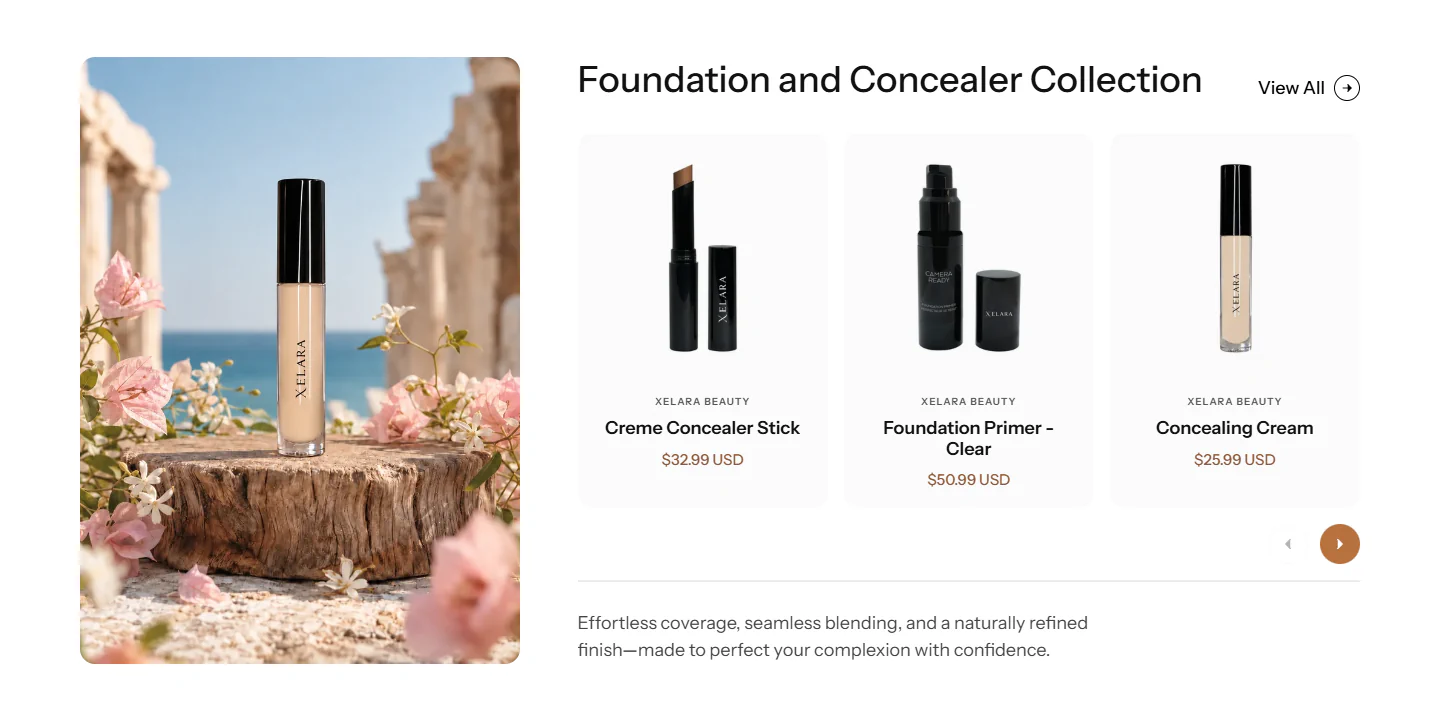
Xelara Beauty sells makeup, skin care, hair, body and men's care, and needed a premium, editorial storefront for a launch catalog of 100+ products. The brand's Figma designer created the visual design, and I built the store from it as a custom theme on Shopify's Dawn foundation, with 9 custom homepage sections, a mega menu for the whole range and local-currency prices for each market.

My role

I built the whole store from the brand's Figma designs: the custom theme and its sections, the navigation, and the collection structure the catalog sits in. The visual design is the work of the brand's own designer.

Visit the live store (opens in a new tab)

Built with

  • Shopify
  • Liquid
  • Dawn 16
  • Online Store 2.0 sections
  • Shopify Markets

Proof

  • 9custom section types built for the homepage
  • 103 · 301products · variants in the launch catalog (as of 17 Oct 2026)
  • 36collections that organize the catalog (as of 17 Oct 2026)
  • 0third-party app scripts on the homepage (checked 17 Oct 2026)
Read the full case studyHide the case study

The brief

Xelara Beauty sells across five categories: makeup, skin care, hair, body and men's care. The brand needed a storefront that feels premium and editorial, keeps a launch catalog of 100+ products easy to browse, and sells in more than one country. The brand's Figma designer created the visual design; my job was to turn those designs into a working Shopify store that matches them closely.

Key decisions, in plain English

  1. Start from Dawn, customize where it shows. Dawn is Shopify's own reference theme, so the cart, product pages and collection filters start from code Shopify maintains. The custom work went into what shoppers notice first: the homepage, the header and the product rows.
  2. One product slider, set up 4 ways. The Bestsellers, Foundation and Concealer, Moisturizer & Serum and Lip Essentials rows are one reusable section with different settings, not 4 one-off sections. The next row is a few clicks in the theme editor, not new code.
  3. Custom styles kept apart from Dawn's. The custom sections keep their styles in their own files and use an "xel-" class prefix, so they don't collide with Dawn's own styles, and future Dawn updates are safer to apply.
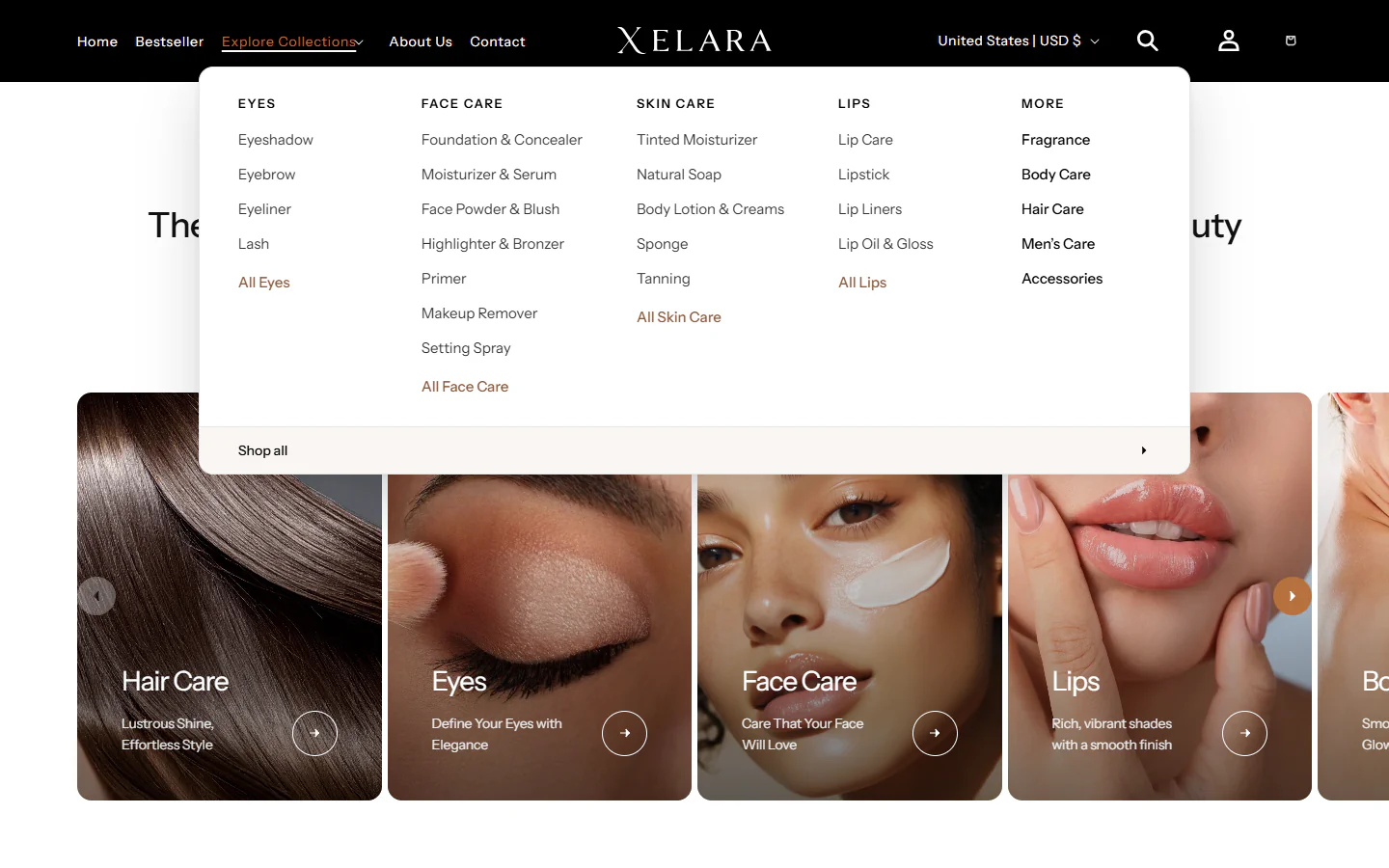
  4. A mega menu for a big catalog. With 36 collections, a plain dropdown would bury most of the range. "Explore Collections" opens one panel with Eyes, Face Care, Skin Care and Lips, plus Fragrance, Body Care, Hair Care and Men's Care.
  5. Local prices in each market. Shopify Markets shows prices in the shopper's currency, such as US dollars in the US and UAE dirhams in the UAE, and a country selector in the header lets shoppers switch.
  6. No app bloat. The sliders, the menu and the other homepage features are part of the theme, so the homepage loads no third-party app scripts: only the store's own files and Shopify's, including Shop Pay.

What shipped

  • A live store with a launch catalog of 103 products, 301 variants and 425 product images in 36 collections (as of 17 Oct 2026).
  • 9 custom section types on the homepage, including the hero, the category grid, the reusable product slider (used 4 times), about and why-us blocks, and an Instagram feed.
  • A custom header with the "Explore Collections" mega menu and a country selector.
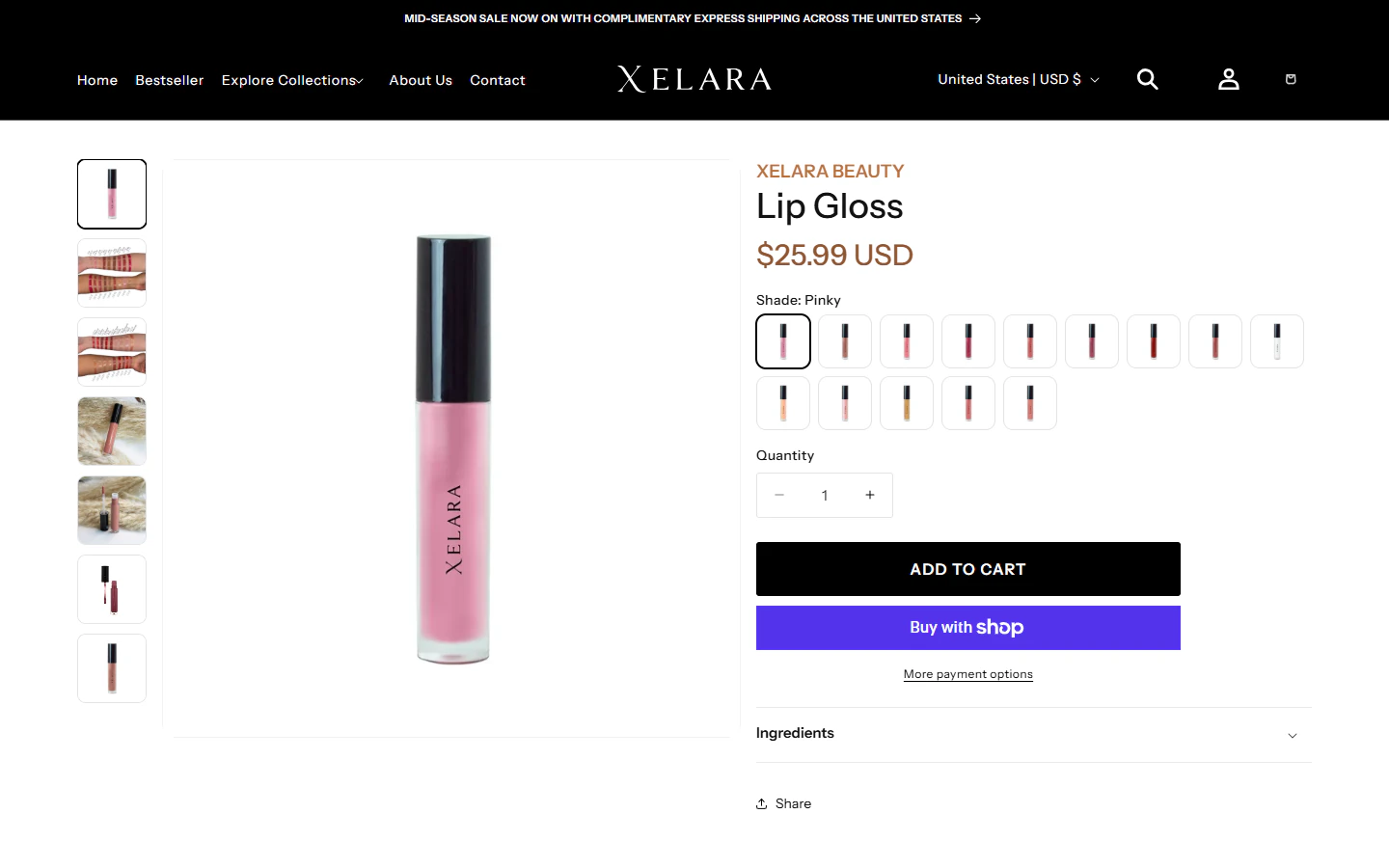
  • Product and collection pages in the brand's style: photo shade swatches (14 on the Lip Gloss page), filters, sorting and breadcrumbs, with Add to cart and Shop Pay.
  • Local-currency prices for each market, through Shopify Markets.
  • No third-party app scripts on the homepage (checked 17 Oct 2026).

Xelara Beauty is a client project, shown with the client's approval. Visual design by the brand's Figma designer; store build by me. The store facts here were checked on the public storefront on 17 Oct 2026. Sales and traffic figures belong to the client and are not shared.

Want a Shopify store like this for your brand?

Email me LinkedIn (opens in a new tab)
  • 03
  • Own product · Founder
  • Jul 2026 – Present
  • Live
  • Public launch 31 Oct 2026

A branded checkout & payments SaaS for Shopify merchants

It is built for Shopify merchants who need an alternative payment provider, including stores in countries where Shopify Payments isn't available. A branded hosted checkout takes payment into the merchant's own account on a third-party payment platform, and the paid Shopify order is created automatically. It is live with self-serve sign-up, and the public launch is planned for 31 Oct 2026.

My role

Founder. I set the requirements and the money-safety rules, made the system-design calls and sign off each release. The product name goes public at launch; until then I share it, with a demo, on request.

Built with

  • Shopify Admin API
  • Google Ads

Proof

  • 15 minreconciliation that alerts on any payment without an order
  • 3 eventstracked in Google Ads for each merchant: add-to-cart, begin-checkout and purchase
  • 5 → 1copied setup values replaced by a single API key
  • 30 daysfirst-click attribution window in the built-in affiliate program
GOOGLE ADS · PER MERCHANT PAYMENT TO ORDER RECONCILIATION Shopper Branded hosted checkout Merchant's own payment account Payment notice Duplicate-proof settlement Paid Shopify order on the merchant's Shopify store the merchant's brand · prices from Shopify on a third-party payment platform verified · can arrive more than once each payment can be claimed only once created automatically, ready to fulfill checks out pays sends a notice first notice claims it creates the order re-sent notice or retry already claimed: no second order add-to-cart begin-checkout purchase ad click carried to the checkout ad click kept with the order payment records orders Every 15 minutes checks the payment platform's own records against orders ! Alerts on any payment without an order so a person can resolve it SELF-SERVE ONBOARDING · 5 STEPS, EACH CHECKED LIVE 1 2 3 4 5 Connect Shopify Payment account Checkout address Switch on Connect your store keys checked live just 1 API key own subdomain optional all checks run again one theme line → Live each step is verified live before the next one opens payment setup: 5 copied values → 1 API key
How a checkout payment becomes a paid Shopify order: the money goes straight to the merchant, each payment can be claimed only once, and a 15-minute reconciliation alerts on any payment without an order. Open the diagram full size (opens in a new tab)
Read the full case studyHide the case study

The problem

Some Shopify merchants need an alternative payment provider, including merchants in countries where Shopify Payments isn't available. They still want a branded checkout, money paid into their own account, and real paid orders in Shopify, so their order and fulfillment workflow keeps running. Doing this safely is mostly a money problem: the payment and the order live in two systems, and payment notifications get re-sent.

What I did

I built and launched it as a self-serve platform: merchants sign up, connect their store and payment account, and pay per store. There's a public demo, and the public launch is planned for 31 Oct 2026.

Product and system-design decisions, in plain English

  1. The money goes straight to the merchant. The shopper pays into the merchant's own payment account, and the paid order is created in Shopify automatically, so fulfillment and the merchant's other apps keep working.
  2. Duplicate-proof settlement. Payment platforms re-send notifications, and requests get retried. Each payment can be claimed only once, so a re-sent notification or a retry can never create a second order.
  3. Nothing stuck goes unnoticed. A 15-minute reconciliation alerts on any payment without an order, so a person can resolve it.
  4. Ad tracking per merchant (my PPC background). Each merchant gets their own Google Ads conversion tracking for add-to-cart, begin-checkout and purchase, with the ad click carried over from the store to the checkout.
  5. Onboarding without an operator. A self-serve 5-step wizard. Payment setup went from 5 copied values to 1 API key.
  6. Growth built in. An affiliate program with 30-day first-click attribution.

How I built it

I wrote the requirements and the rules the money path must never break, starting with "no duplicate orders", and I made the system-design calls above. The build includes an automated test suite that checks those rules. I run the platform: releases, reconciliation alerts and fixes.

Results

  • Live, with self-serve sign-up, a public demo and per-store subscription billing. Public launch planned for 31 Oct 2026.
  • Duplicate-proof payment-to-order settlement: re-sent notifications and retries can't create a second order.
  • 15-minute reconciliation that alerts on any payment without an order.
  • Per-merchant Google Ads conversion tracking for add-to-cart, begin-checkout and purchase.
  • Self-serve 5-step onboarding; payment setup cut from 5 copied values to 1 API key.
  • An affiliate program with 30-day first-click attribution.

Want the product name and a demo before the launch?

Email me LinkedIn (opens in a new tab)
  • 04
  • Own product
  • Sep 2026 – Present
  • Live

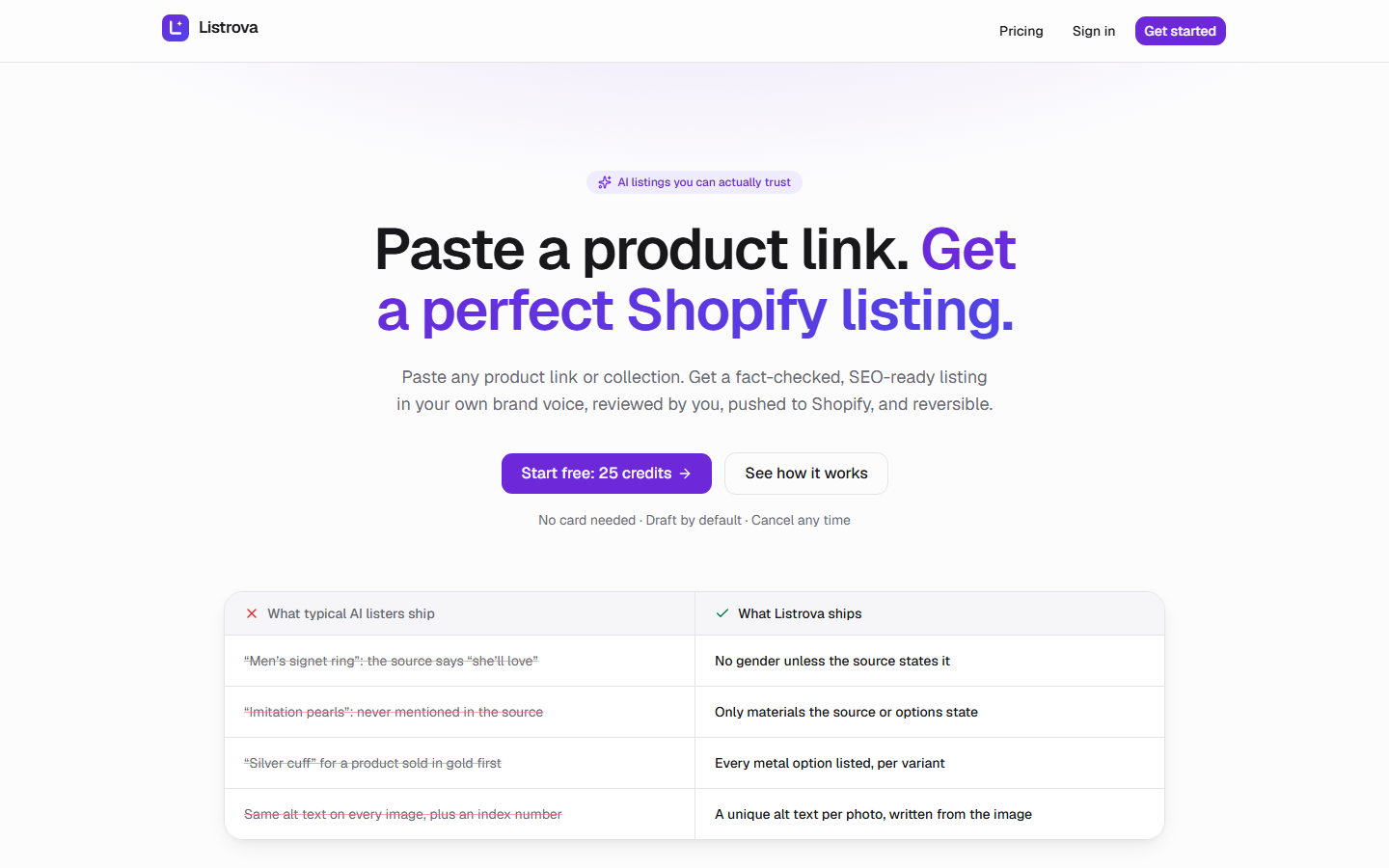
Listrova: an AI product-listing SaaS for Shopify

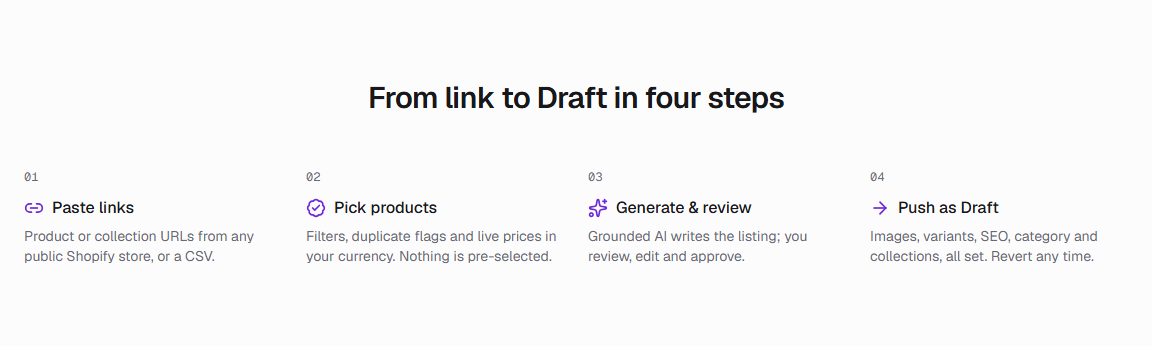
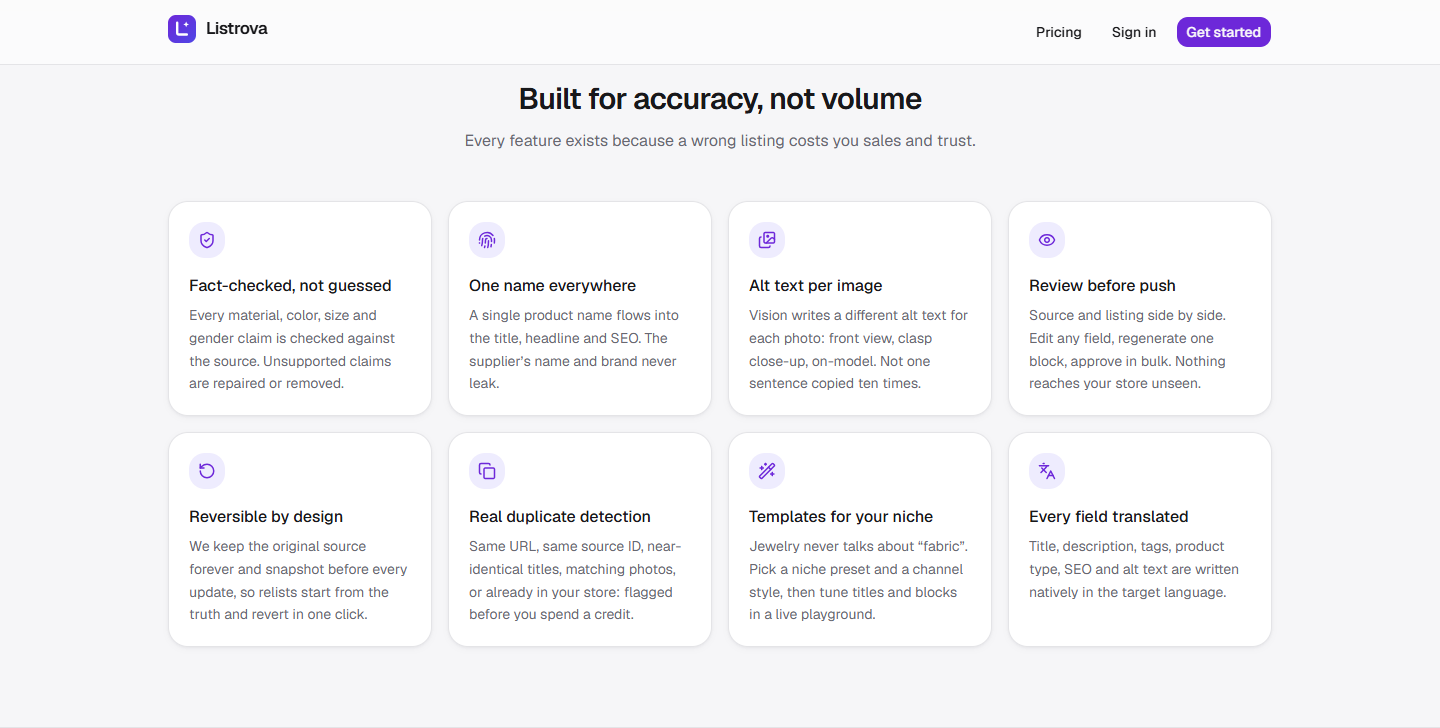
Paste a product link and get a fact-checked, SEO-ready listing. Review it, push it to Shopify as a draft, and revert it with one click. By testing AI models on a fixed set of 16 products, I cut the AI cost per listing by about 70%, to about $0.03, and every product passed all 7 quality checks.

My role

Creator. I owned the product and designed the evaluation that decided which AI model shipped.

Visit Listrova (opens in a new tab)

Built with

  • Shopify Admin API
  • Claude API

Proof

  • 16/16test products passed all 7 hard checks
  • ~$0.03AI cost per listing
  • ~70%lower AI cost than with my first model choice (~$0.11)
  • ~13 smedian time to generate a listing
Read the full case studyHide the case study

The problem

Merchants and dropshippers who import products need listings that are accurate, SEO-ready and in their own brand voice. AI writes them fast, but it can also invent facts, overwrite good data and get expensive per listing. To work as a product, every listing has to be correct, easy to undo and cheap to generate.

What I did

  • Built and launched Listrova: from a product link to a reviewed draft in Shopify, with a one-click revert.
  • Safe by default: products go to Shopify as drafts first, and every change can be reverted exactly. Credits are charged only when a product actually reaches Shopify, and a retried request is never charged twice. Store access tokens are encrypted.
  • Designed a test-set evaluation: a fixed set of 16 test products (the "golden set"), each scored against 7 hard checks, to compare AI models and settings on accuracy, cost and speed.

How I built it

I defined the listing pipeline, the hard checks every listing must pass and the cost target, then built the app against them. The golden set was the testing gate: it decided which model and settings shipped.

Results

  • 16/16 golden-set products passed all 7 hard checks (100% hard-check pass rate).
  • About $0.03 per listing, with a median of about 13 seconds per listing.
  • About 70% lower AI cost than with my first model choice (about $0.11 per listing).

Want product listings or SEO automated for your store?

Email me LinkedIn (opens in a new tab)
  • 05
  • Own product
  • Sep 2026
  • Deployed

ListingLift: AI product SEO in an embedded Shopify app

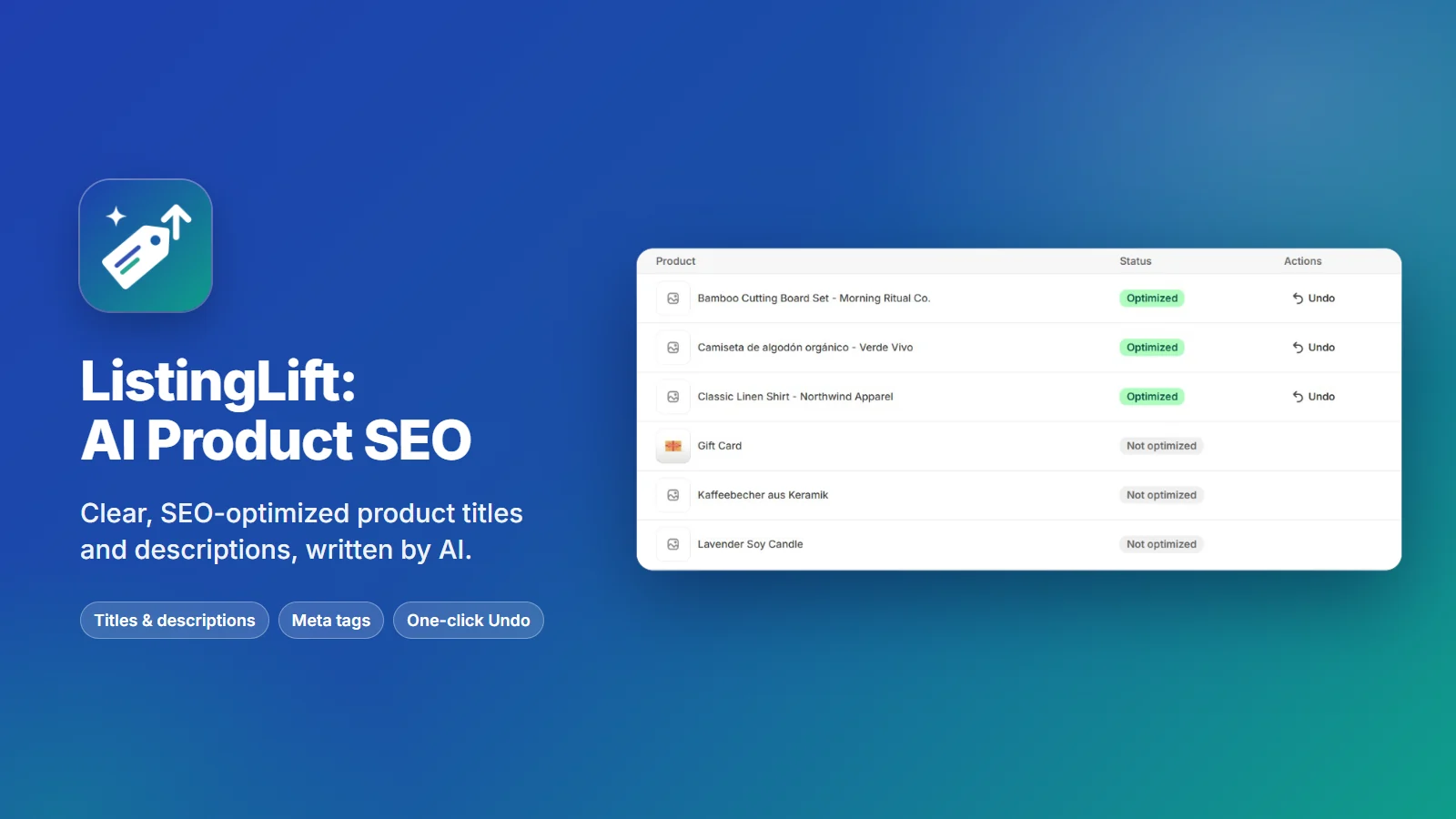
ListingLift works inside Shopify admin. It rewrites product titles, descriptions and meta tags from each product's own data. One click undoes any change exactly, and merchants buy credit packs through Shopify. I checked it against the Shopify App Store requirements before calling it ready.

My role

Creator. I picked the problem, wrote the App Store checklist and decided what each test had to prove. It is not yet listed on the Shopify App Store, and a 2:40 demo video is available on request.

Built with

  • Shopify Billing API
  • Claude API

Proof

  • 30 · 0 · 1met · failed · needs a manual check, of 31 Shopify App Store requirements I checked
  • 1 clickto undo any AI rewrite exactly
  • 0charges for failed AI jobs
  • Exactly 10of 20 simultaneous credit requests went through against a balance of 10
Read the full case studyHide the case study

The problem

Merchants want better product titles, descriptions and meta tags for search. But rewriting them in bulk with AI is risky: the AI can invent product features, and the changes are hard to undo. A Shopify app also has to meet the App Store's requirements before it can be listed, from billing to privacy.

What I did

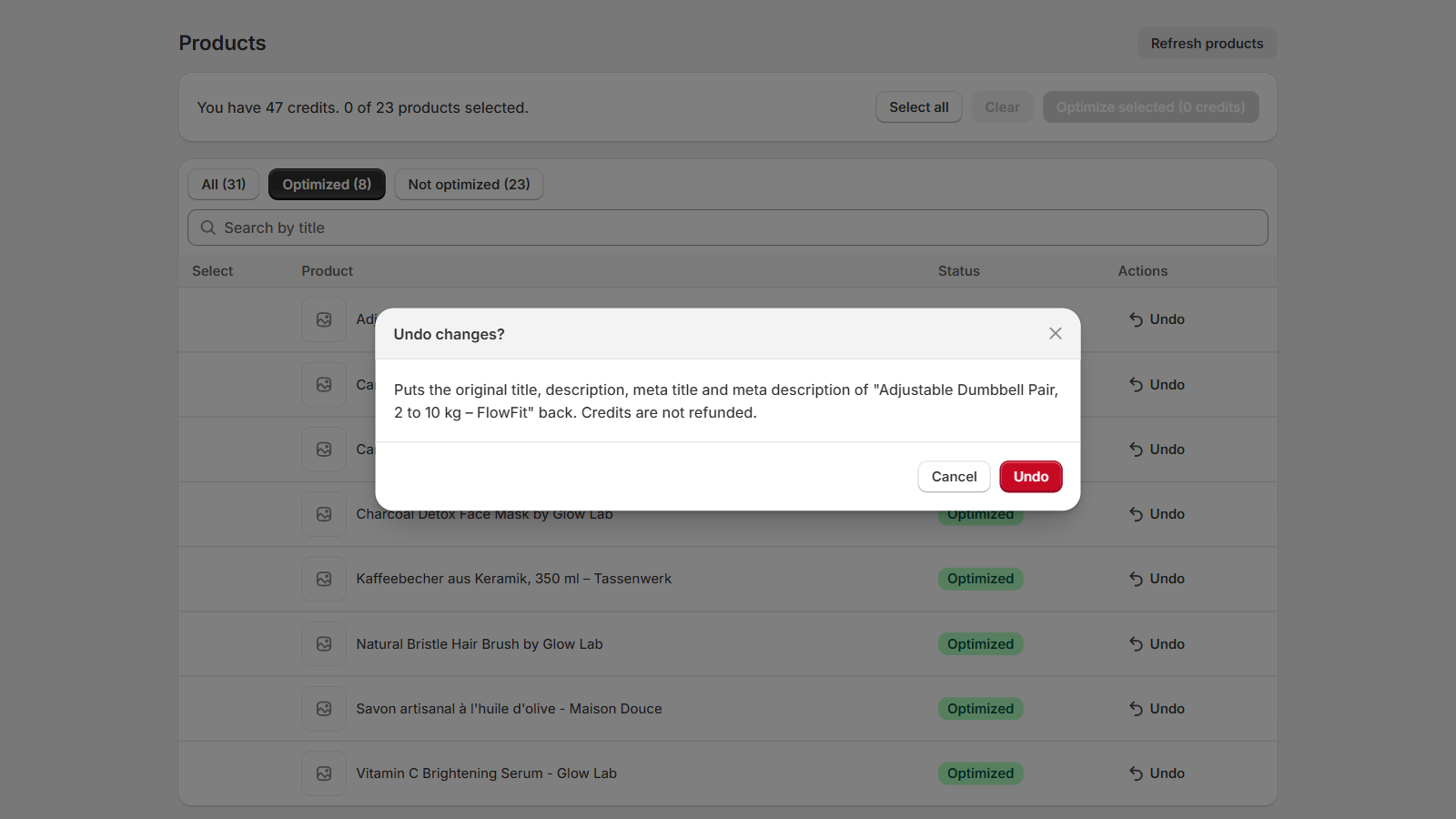
  • Built ListingLift, an app inside Shopify admin that rewrites titles, descriptions and meta tags from each product's own data, with an exact one-click Undo.
  • Billing through Shopify: merchants buy credit packs through the Shopify Billing API.
  • Fair credit billing: a store can never spend more credits than it has bought, and failed AI jobs are never charged.
  • App Store readiness: Shopify's privacy (GDPR) data requests and app uninstalls are handled and verified, and I checked the app against 31 Shopify App Store requirements.
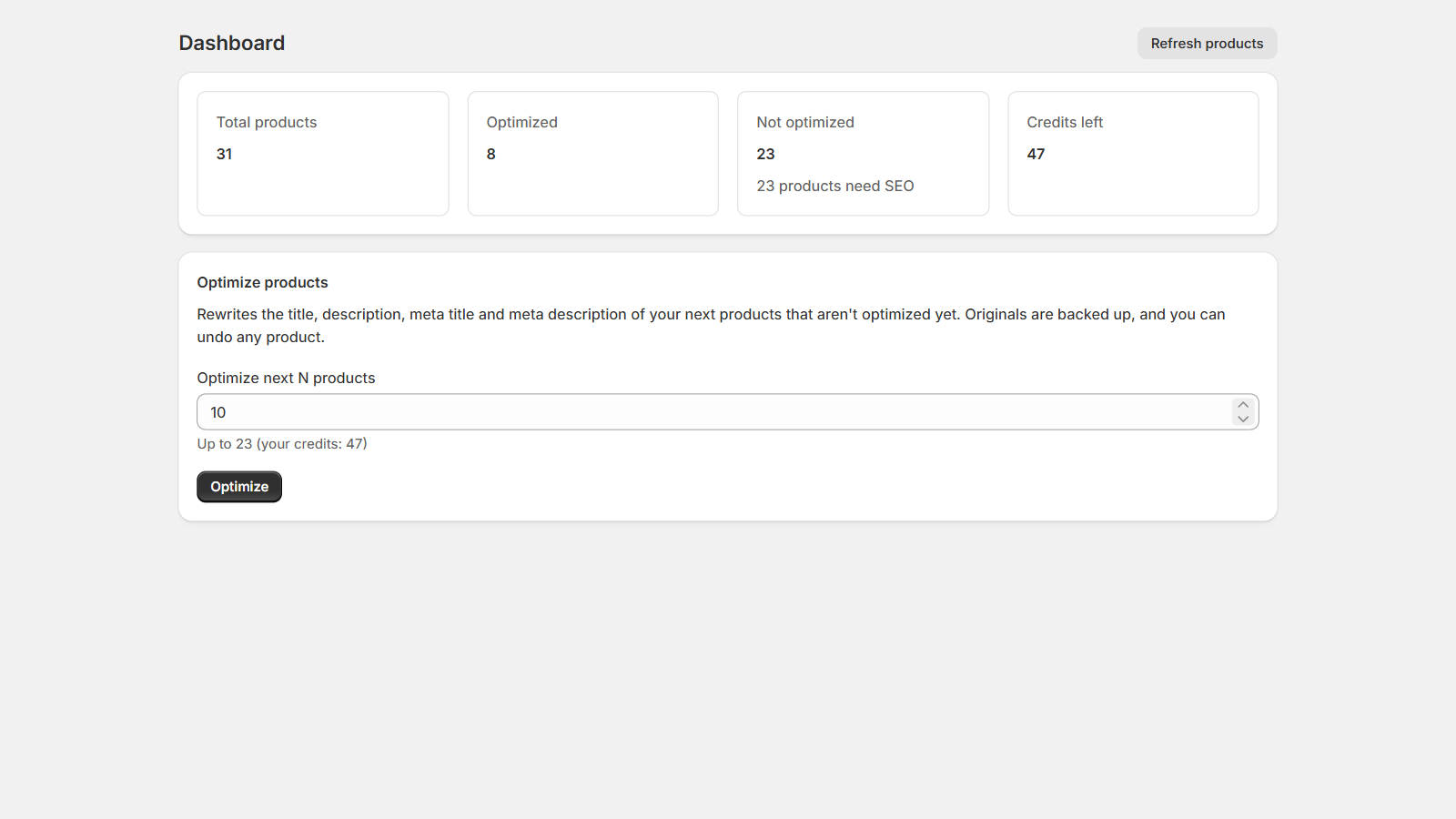
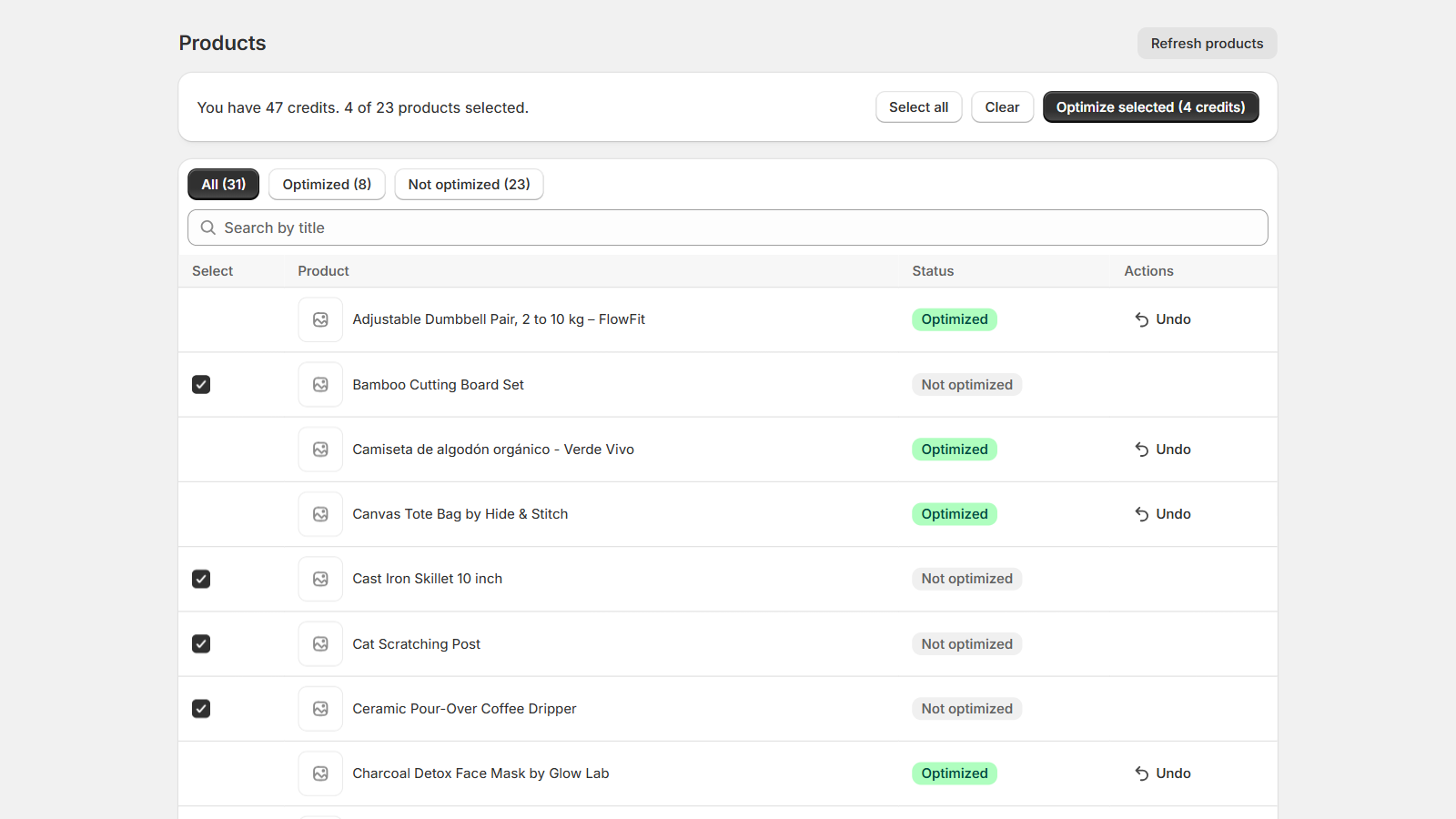
ListingLift products page with filters, search, status badges and products selected for bulk optimization (opens full size in a new tab)
Products: filter, search and pick the products to optimize (development store, sample products).

How I built it

I chose the problem and wrote the requirements and the App Store checklist, then built the app on Shopify's official app template with the Shopify CLI. QA ran against the deployed app, and the requirements check was the final gate.

Results

  • Checked against 31 Shopify App Store requirements: 30 met, 0 failed, 1 still needs a manual check.
  • Failed AI jobs are never charged, and every change can be undone exactly.
  • Credits can't be overspent: in a test, 20 simultaneous credit requests against a balance of 10 got exactly 10.

Want to see the 2:40 demo video?

Email me LinkedIn (opens in a new tab)

Current role · Mar 2026 – Present

E-Commerce Readiness Hub Faisalabad

Manager E-Commerce (Center Incharge) · Punjab Information Technology Board (PITB)

PITB, the Government of Punjab's IT agency (est. 1999), delivers the Punjab E-Commerce Initiative. Its four E-Commerce Readiness Hubs help SMEs, artisans and home-based sellers get ready to sell online, free of charge. They provide product photography, creatives, social media content and audits, branding, and online-store guidance.

I run the Faisalabad hub and lead its team of 5. I also built the hub's operations portal (case study).

  • 100+businesses onboarded
  • 45completed the full readiness package
  • 4,400+photos, creatives and reels delivered
  • ~5 wksmedian from first visit to completion
  • 5specialists on the team I lead
  • 8+e-commerce workshops delivered

Aggregate program figures only, as of October 2026: businesses onboarded as of Oct 2026, completions and files delivered as of 16 Oct, and the median as of 9 Oct. PITB is named only to describe my role. This personal site is not affiliated with or endorsed by PITB or the Government of Punjab.

How I work

How I build

I design the product and the system, then ship fast with AI tools (Claude Code + MCP connectors: Magic Patterns, Higgsfield, Canva, Playwright) on Supabase, Inngest and Railway, under strict testing.

  1. 1Me

    Product

    I pick problems worth solving from real operations: my hub's workflow, and the payment and listing problems merchants face.

  2. 2Me

    Requirements

    I define what "done" means and what must never happen: no duplicate orders, and no sign-off without files.

  3. 3Me

    System design

    I make the system-design calls and their trade-offs: what the database enforces, what gets reconciled, and what stays manual.

  4. 4AI tools

    Implementation

    Built phase by phase with Claude Code, with tests written against those rules and MCP connectors for UI design and browser QA.

  5. 5Me

    Testing

    I decide what each test and evaluation has to prove, and I check the results before anything ships.

  6. 6Me

    Launch & operations

    I launch and run what I build: monitoring, reconciliation alerts, data-quality checks and fixes in production.

My toolchain

These are the tools I ship with. I own the product, requirements, system-design decisions, testing and launch.

  • Claude CodeAI coding agent
  • Magic PatternsUI design
  • HiggsfieldLaunch videos and reels
  • CanvaGraphics and social creatives
  • PlaywrightQA and browser automation
  • SupabaseDatabase
  • InngestBackground jobs
  • RailwayHosting
  • Shopify CLIShopify apps and themes
  • Claude APIAI features inside the products

The checks behind the work

  • 950+passing automated tests on the Hub Operations Portal (as of 16 Oct 2026)
  • 15 minreconciliation that alerts on any payment without an order (checkout SaaS)
  • 16/16test products passed all 7 of Listrova's hard checks
  • 30 · 0 · 1met · failed · manual check, of 31 App Store requirements (ListingLift)

Speed, with checks. The hub's operations portal went from approved plan to production in about two days (2 → 3 Oct 2026), and 950+ passing automated tests now back it up.

No inflated numbers. Every result here is dated or tied to a named test, and I can walk you through how each one was measured.

Experience

Where I've done the work

  1. Mar 2026 – Present · Full-time

    Manager E-Commerce (Center Incharge)

    Punjab Information Technology Board (PITB) · Punjab E-Commerce Initiative, E-Commerce Readiness Hub Faisalabad

    I run the hub and lead a team of 5. As of Oct 2026: 100+ businesses onboarded, 45 through the full readiness package, 4,400+ assets delivered by the team, and 8+ workshops I delivered. I built the hub's operations portal.

  2. Aug 2020 – Present · Part-time, project-based

    Freelance E-commerce & Shopify Specialist

    Self-employed · remote, international clients

    Shopify store builds and theme customization. Branding and design projects, delivered with a small remote design team I managed. Google Merchant Center and Shopping/Search ads, including for a US pet-supply store with a 100K+ SKU catalog. Social media management, and since 2026, AI social-media automation for clients.

  3. 2026 · Own products

    Selected projects

    A branded checkout & payments SaaS for Shopify merchants (Founder; public launch 31 Oct 2026) · Listrova · ListingLift

    I own each product end to end, from requirements and system design to testing and launch. Details are in the case studies above.

  4. Jun 2020 – Jun 2022 · Part-time

    Trainer, Digital Marketing & E-commerce

    e-Rozgaar Program, Punjab Information Technology Board (PITB) · Faisalabad

    I trained 1,000+ graduates in SEO, social media marketing, Facebook and Instagram ads, Shopify store setup and freelancing.

  5. Apr 2015 – Mar 2019 · Self-employed

    Affiliate Marketer

    CPA lead generation (MaxBounty network)

    I ran paid-traffic lead-generation campaigns, with landing pages and funnels. This is where my performance-marketing work started.

Work with me

Ways we can work together

Contract, part-time or project work, fully remote, directly for brands or white-label for agencies. I work UK afternoons and US East Coast mornings, and async with teams in Australia.

Remote E-commerce Manager

Contract or part-time roles with DTC brands and agencies. I cover Shopify operations, product listings, Google Ads and Merchant Center, Meta Ads, team workflow and reporting, and I add automation where it pays off.

Best for: teams that want one owner for store operations, paid growth and reporting.

Shopify store fixes

Up to 10 agreed fixes on a duplicate of your theme: section and layout edits, product and collection templates, product listings, app clean-up, and image and speed hygiene. You approve each change before it goes live. Fixed price: $600, in 5 business days.

Best for: a store with a list of issues, messy product data or slow pages.

Google Merchant Center & Shopping fixes

I fix feed errors, disapprovals and product data, set up or reset Shopping and Search campaigns, and check that conversion tracking records sales correctly. It starts with a fixed-price audit: $397 in 3 business days, with a top-10 fix list ranked by revenue impact, and the fee is credited if you book the fixes within 14 days.

Best for: stores with disapproved products, or Shopping campaigns that need a reset.

AI automations & apps for Shopify

Automation for product listings and SEO, social media content, internal portals, data-quality checks and automated reports. I build them and test them before handover. Fixed price: from $750 for one workflow in 5–7 business days.

Best for: repetitive work in listings, reporting or operations that should run itself.

How engagements run

  • Written scope agreed before work starts
  • Collaborator access, never shared passwords
  • Theme changes on a duplicate theme or development store first
  • NDA on request
  • Clear handover: what changed, how to use it and how to undo it
  • Honest about what I tested and what still needs a check

Contact

Let's talk

Hiring an e-commerce manager, need white-label help for your agency's clients, or have a Shopify, Merchant Center or automation problem to solve? Email me a line about what you need, plus the store URL if there is one.

  • Faisalabad, Pakistan
  • UTC+5
  • Remote · UK & US-Eastern hours overlap